Peered Rafiki Instances Architecture
This guide provides an architectural overview of a reference deployment where:
- Account Servicing Entity A (ASE A) runs the Test Wallet from github.com/interledger/testnet and its own Rafiki instance.
- Account Servicing Entity B (ASE B) runs the Interledger App Wallet (container images are available from
ghcr.io/interledger) and its own Rafiki instance. - Both ASEs deploy to Kubernetes clusters (on any cloud provider) using the public Interledger Helm charts served from
https://interledger.github.io/charts/interledger. - The two Rafiki instances are peered, enabling their users to send Interledger payments between ASE A and ASE B.
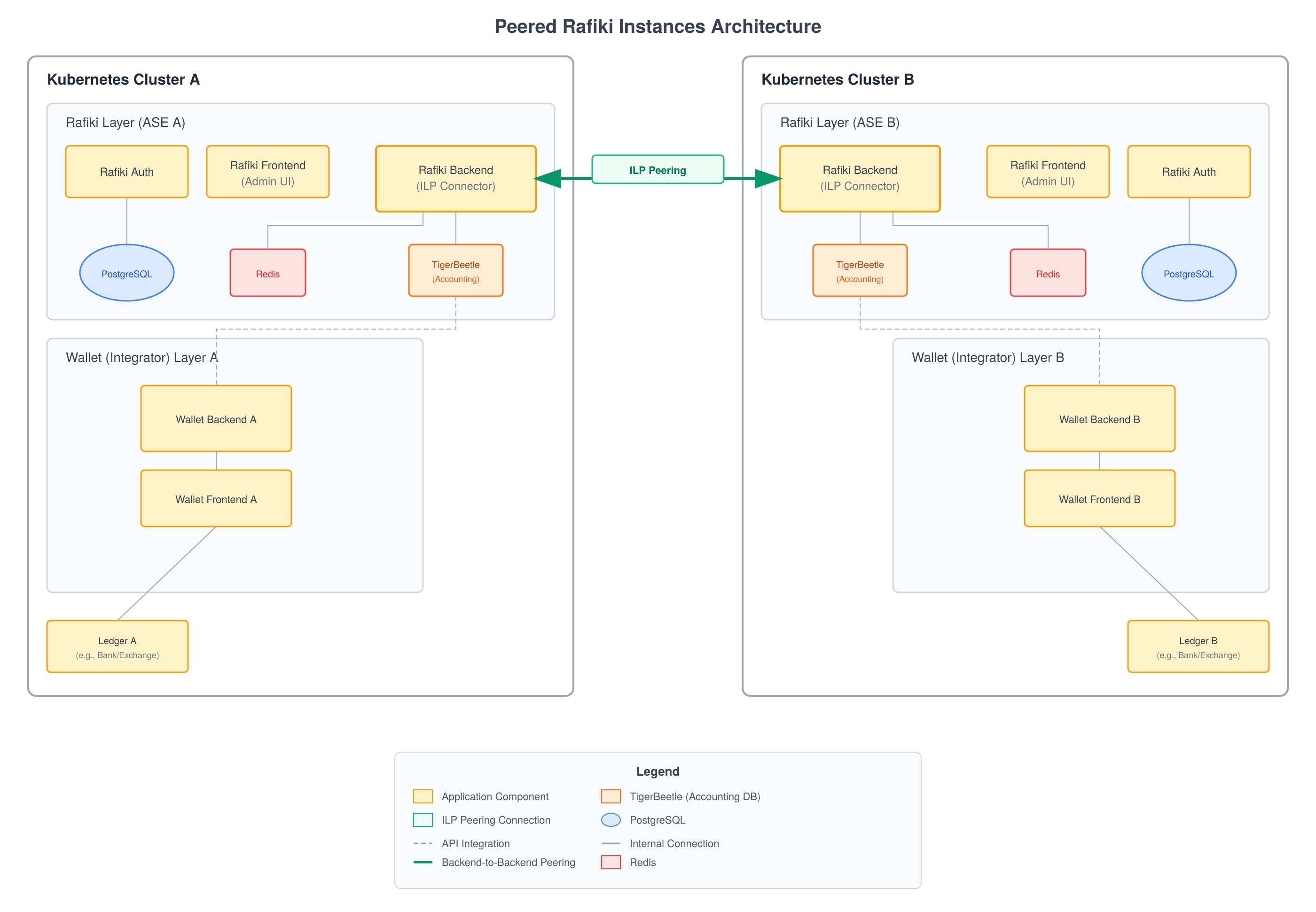
Each ASE deployment consists of:
- Rafiki Layer:
auth– Open Payments authorization server.backend– Open Payments resource server and ILP connector.frontend– Rafiki Admin UI.
- Wallet (Integrator) Layer:
- Wallet backend – Integrates with Rafiki via Open Payments APIs.
- Wallet frontend – User-facing web app.
- Data stores:
- PostgreSQL – Open Payments resources and wallet addresses database.
- Redis – Caching and session management.
- TigerBeetle – High-performance accounting database for Rafiki.
- Ingress / DNS:
- Kubernetes Ingress exposes Rafiki and wallet HTTP endpoints with TLS.
- Public DNS records point to the ingress IPs or load balancer hostnames.
The deployment uses two independent Kubernetes clusters, one per ASE. Each cluster can be deployed on any cloud provider (AWS EKS, Google GKE, Azure AKS) or on-premises:
- Kubernetes Cluster A (for example,
ase-a-cluster):- Namespace
rafiki-ase-a(Rafiki Layer) - Namespace
wallet-ase-a(Test Wallet Layer)
- Namespace
- Kubernetes Cluster B (for example,
ase-b-cluster):- Namespace
rafiki-ase-b(Rafiki Layer) - Namespace
wallet-ase-b(Interledger App Wallet Layer)
- Namespace
Each cluster has:
- A Rafiki instance fronted by an HTTPS ingress (Open Payments + Admin + Auth endpoints).
- A wallet app fronted by an HTTPS ingress (user-facing web app + API).
- Private services for databases, Redis, and Rafiki connector endpoints.
- ILP Peering connection between the two Rafiki backend connectors.
The following diagram shows the major components and how they interact:
-
Public Helm repository:
Terminal window helm repo add interledger-helm https://interledger.github.io/charts/interledgerhelm repo updateCharts used:
interledger-helm/rafiki– Rafiki instance (auth, backend, frontend)interledger-helm/testnet-wallet– Example wallet implementationinterledger-helm/ilf-wallet-backend– Interledger App wallet backendinterledger-helm/ilf-wallet-frontend– Interledger App wallet frontendinterledger-helm/ilf-wallet-admin– Interledger App wallet admin
-
Git repositories:
- Rafiki: github.com/interledger/rafiki
- Testnet Wallet: github.com/interledger/testnet
- Helm charts: github.com/interledger/charts
- Deploy ASE A (Rafiki + Test Wallet): refer to Deploy ASE A using Test Wallet.
- Deploy ASE B (Rafiki + Interledger App Wallet): refer to Deploy ASE B using Interledger App Wallet.
- Peer the Rafiki instances to enable Interledger payments: refer to Peer ASE A and ASE B.